Karma Dharma
The common phrase "as you sow, so shall you reap" in life concisely sums up the law of Karma. Karma can be seen as the universal Hindu law of cause and effect, which holds a person responsible for their actions and effects. Karma - human deeds or actions, we all are constantly performing physically, mentally, or spiritually. Whatever good or bad consequences occur in our lives, we need to know, that we are responsible for it, which means to a certain degree, we create our destiny. Nothing in this world ever happens accidentally or coincidentally, there is always going to be a reason, behind it. So, good actions will produce happiness, and every bad action, will bring misery. Indeed it is not a law as there is no one behind as a lawgiver. It is intrinsic to existence itself, the very nature of life- whatsoever you sow, you reap. Deeply complex too. Karma and rebirth is a prevalent theme in the Upanishads.
In a general sense, karma means all actions and functions of the mind and body. Karma is also used to denote moral or professional duty, sacrifice, religious rite, result, consequences, cause and effect, fate, and movement.
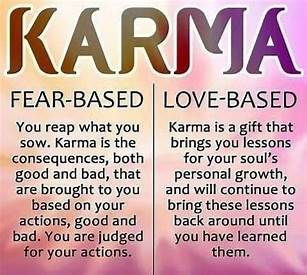
Every crime against one’s nature, each one, without exception, records itself in our unconsciousness – what the Buddhists call alayavigyam, the storehouse of each crime.
And what is a crime? - It is not because the court of Manu says so, not because the Ten Commandments say so, not because certain government says so, none is relevant, then what is it, there has to be a universal definition to it. My Guru had a simple deep definition - that which goes against our nature, that which goes against ourselves, our being, is a crime. Now, how to know? So whenever we commit a crime, it gets recorded in our unconsciousness, in a certain way, that we start having the feeling of guilt. We start feeling despised by ourselves, we start feeling unworthy, and we feel about ourselves as we should not be. It is like something inside us, becomes hard, something deeply closed inside us. Like something is solid, frozen within, that hurts, brings pain, a feeling of unworthiness and the flower we are is no longer blossoming as it should.
Karen Horney says – “it registers”.. indeed whatever we do, gets registered automatically and the flow stops, as a feeling of being something below human, a feeling of inferiority starts – flow is only possible when we expose ourselves, when we are available.
Abraham Maslow says “If we do something, we are ashamed of, it registers to our discredit. And if we do something good, it registers to our credit” and indeed, we can observe, and watch it. The law of karma is not some philosophy, some abstraction, it is simply a theory which explains something true inside our being. So, we will either respect ourselves or feel contemptible, and worthless within ourselves. Every moment, we are creating ourselves, so either a grace will arise or a disgrace, this is the law of karma. By watching, observing, understanding, and knowing the inevitability of it, we will be as my Guru says – a different person.

Comments