Understanding Gunas make it happen

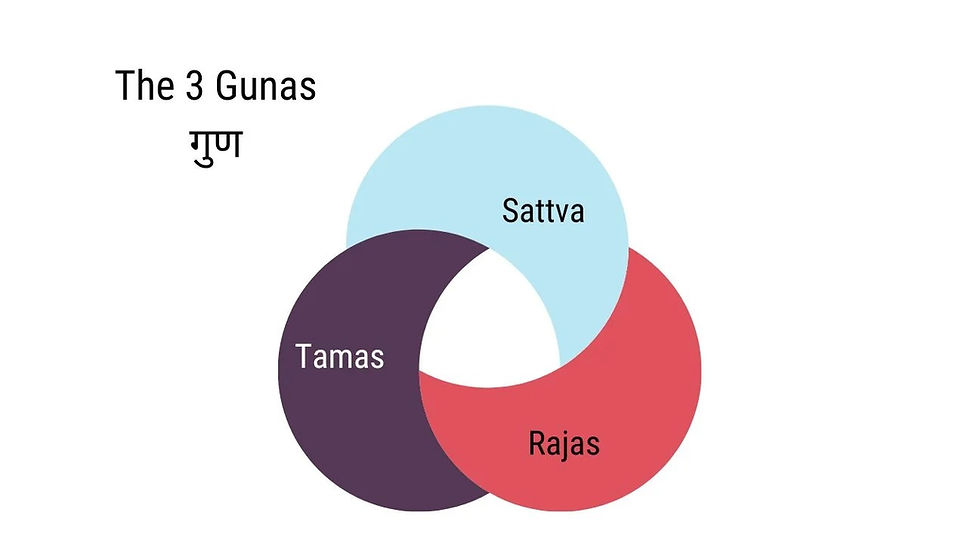
In the creation of the universe a pure consciousness (three states of energy) comes into play, the three states we are talking about here are known as Gunas, literally meaning ropes that bind us to the physical world. Gunas – aspects of nature, the three gunas are – sattva, rajas, and tamas.
Where sattva is responsible for prakasha(illuminating), rajas for kriya(activity), and tamas for sthiti(inertia), gunas can be seen as fiber is woven together to form the objective universe.
Now these gunas are present in every object and aspect of Nature, and it is their permutation, union, and combination which brings forward results diversified – dharma (inherent nature), lakshana (qualities), avastha (conditions) which results in turn into svabhav (specific behaviors) of objects and the beings.
Now in Vedanta, Hindu, and Yogic philosophy, there is this Sanskrit word – vasana which refers to unmanifested desire or samskaras (latent karmic imprints). Vedanta and Hindu Yogic Philosophy believe that human beings are essentially Atman – eternal self, enlivened in body, mind, and intellect – this jiva as it is known is composed of three qualities, known as gunas, which determine our level of consciousness and thus make up personality.
Krishna in Bhagavad Geeta says that those gunas are so influential that they seemingly influence us against our will. But what exactly determines our gunas and where do they come from?
The gunas are meant to facilitate this spiritual endeavor as they reveal and conceal us all to draw us closer to knowing the knower, Purusa, dependent on Prakriti. Purusa has the power of perceiving whereas Prakriti has the power of acting. Prakriti is a fire that is burned by Purusa.
It is vasanas that determine the gunas – the latent, unmanifested, results of actions of the past that have created well-worn energetic paths of least resistance.
Artharveda
The Lotus Flower Of Nine Doors, Covered With Three Strands, What Prodigy There Is Within It, That Is The Brahman – Knower’s Know.It Is Seen That The Results Produced By The Gunas Exist In Nature In Specific (Visesa), Generic (Avisesa), Gross (Sthula) And Subtle (Linga) Forms.The Distinction Of Past, Present, And Future Also Arise From The Gunas Depending Upon Whether They Are Active Or LatentThe Gunas Are Also Responsible For Suffering Arising From The Modification Of The Mind.
One of the objectives of yoga practice is to cultivate sattva and gradually become indifferent to them.
Patanjali states (1.16) that indifference to gunas (guna vaitrsnyam) is superior to even renunciation.
YOGA SUTRAS (CH 4 – VERSE 7&8)
karma aśukla akṛṣnaṁ yoginaḥ trividham itareṣām
The yogi’s actions are neither black nor white; the actions of others are black or white or both.
tataḥ tadvipāka anuguṇānām eva abhivyaktiḥ vāsanānām
Consequences surely follow these inappropriate tendencies.
Vasanas –> feelings -> thoughts –> desires –> resultant action
Vasanas can be therefore seen, as governing the body through the process of becoming feelings, thoughts, desires, and finally our actions.
Now, the results of those actions start to add more Prarabdha Karma (cumulative karma) and more baggage, which means more vasanas. They reside in the Karana Sairia (causal body) and it is said in a sense, these latent desires are the reason for us to continue to exist. Say, you love the practice of Yoga and you practice it, whenever every time you get the time and also create time for it and also study it, well at night you go to sleep, you wake up in the morning and love Yoga continues, you carry within. In our deepest sleep, whatever we love/hate, like/dislike, and think most create seeds of potential, latent, unmanifested desires and this is how vasanas operate from one life to another, cling to us like the smell of smoke long after a campfire has been extinguished.
So, can we do something about our vasanas, that create habits regularly and we act accordingly to them, if so, how?
For this we need to approach to find solutions holistically because we can’t suppress them, nor can we indulge them. Instead, we need to develop an awareness of them, and this can only be accomplished when our mission is one of spiritual evolution, self-knowledge, and liberation. And Yoga, the ancient art, the path is thus there, we need now only steps into – the path can be of Karma/Bhakti/Jnana Yoga and we will be able to watch how our tamasic and rajasic tendencies fall away and are replaced by sattvic pursuits.


Comments